The Poe Toaster is the unofficial nickname given to a mysterious figure who pays an annual tribute to American author Edgar Allan Poe by visiting the author's original grave marker on his birthday. The unexplained tradition began in 1949 and has occurred on the author's birthday (January 19) of every year since
Friday, June 08, 2007
Wikigroaning: A nondestructive Wikipedia game.
The premise is quite simple. First, find a useful Wikipedia article that normal people might read. For example, the article called "Knight." Then, find a somehow similar article that is longer, but at the same time, useless to a very large fraction of the population. In this case, we'll go with "Jedi Knight." Open both of the links and compare the lengths of the two articles. Compare not only that, but how well concepts are explored, and the greater professionalism with which the longer article was likely created. Are you looking yet? Get a good, long look. Yeah.
There are a bunch of article pairs at that link -- it's pretty hilarious, actually, and I don't often say that about somethingawful.
Wednesday, June 06, 2007

Thursday, May 31, 2007
Typowiki is a wiki devoted to typography. It is, of course, in German. But the list of fonts used in corporate logos is pretty great, and comprehensible even to anglophone monoglots like me.
Wednesday, May 30, 2007
Litesum: instant Wikipedia summaries. It's just an ajaxy tool that retrieves the first paragraph of any article, but it's got that relaxing minimalist ethos going.
The best part is that you can type a word, then keep deleting characters from the end and see each article in turn. For example, Food → Foo → FO (disamguation page) → F (the letter).
I think j.w. missed an opportunity to counter some of Colbert's points (though the Report is treacherous waters -- it's possible Wales was desperately pulling on the rigging, trying to steer away from a mock confrontation that would launch hundreds of revert wars).
"Colbert" is, of course, a character, but sometimes the real Colbert uses him as a mouthpiece for his actual ideas -- the last time he mentioned wikipedia, he was genuinely critical of it (for, among other things, not having enough of a sense of humor).
Tuesday, May 29, 2007
It's been a bit morbid around here the past few posts, but still -- you should really read about the Emerald cockroach wasp, which reproduces by controlling the behavior of a cockroach.
Sunday, May 27, 2007
One of George Lawrence's world renowned photographs is of the ruins of San Francisco, California after the 1906 earthquake. It is a 160 degree panorama from a kite taken 2000 feet (600 m) in the air above the San Francisco Bay that showed the entire city on a single 17 by 48 inch contact print made from a single piece of film (Click through to the picture -- it's utterly stunning and about 100 times as large as you expect.)
Saturday, May 26, 2007
Also, William Huskisson was the first person in world history to be killed by a railway accident, but not the first person to be killed by a train. In 1815, sixteen people died after a train's boiler exploded.


Crush, Texas was a temporary "city" established as a one-day publicity stunt in 1896. That year, William G. Crush, general passenger agent of the Katy Railroad, conceived the idea to demonstrate a train wreck as a spectacle. No admission was charged, and train fares to the crash site were at the reduced rate of $5 from any location in Texas. As a result between 30,000 and 50,000 people showed up on September 15, 1896 making the new town of Crush, Texas the second largest city in the state.
Friday, May 25, 2007
Towel Day is celebrated every May 25 as a tribute by fans of the late author Douglas Adams. Update: fixed the link. Argh.
Tuesday, May 22, 2007
Saturday, May 19, 2007
Gliese 581 c is a newly discovered extrasolar planet orbiting the red dwarf star Gliese 581. It appears to be the first extrasolar planet discovered in the hypothetical habitable zone surrounding its star, where surface temperatures might maintain liquid water and therefore be suitable for life as known on Earth.
Friday, May 18, 2007
Thursday, May 17, 2007
The founder of Metafilter has some tips for building a healthy online community. Of relevance to Wikipedians:
When making moderation decisions, don't quote Terms of Service verbatim or legal code. Be honest and phrase things exactly like you would if you were talking to someone standing in front of you. "Hey man, we appreciate your enthusiasm, but what you're doing is uncool because..." is a lot better than "As per the user agreement, you must cease harrassment of other members per Section 10.9.a..."
Tuesday, May 15, 2007
Wednesday, May 09, 2007
Disumbrationism was a hoax masquerading as an artistic school that was launched in 1924 by Paul Jordan-Smith, a novelist, Latin scholar, and authority on Robert Burton from Los Angeles, California.
(I'm taking a bit of a blogging hiatus -- working on some other projects, some wikipedia related, some not. Posts might be a bit less frequent for a week or two.)
Sunday, May 06, 2007
Cool photo of chinese landscape -- looks almost like a vector illustration. Half of the links in the past few days are via reddit, by the way.
Friday, May 04, 2007
Wikitravel seems to be coming into its own. It just won a webby award and it's developing cool articles like Hitchhiking in Japan.
A fainting goat is a breed of domestic goat whose external muscles freeze for roughly 10 seconds when the goat is startled. Though painless, this generally results in the animal collapsing on its side.
Wednesday, May 02, 2007
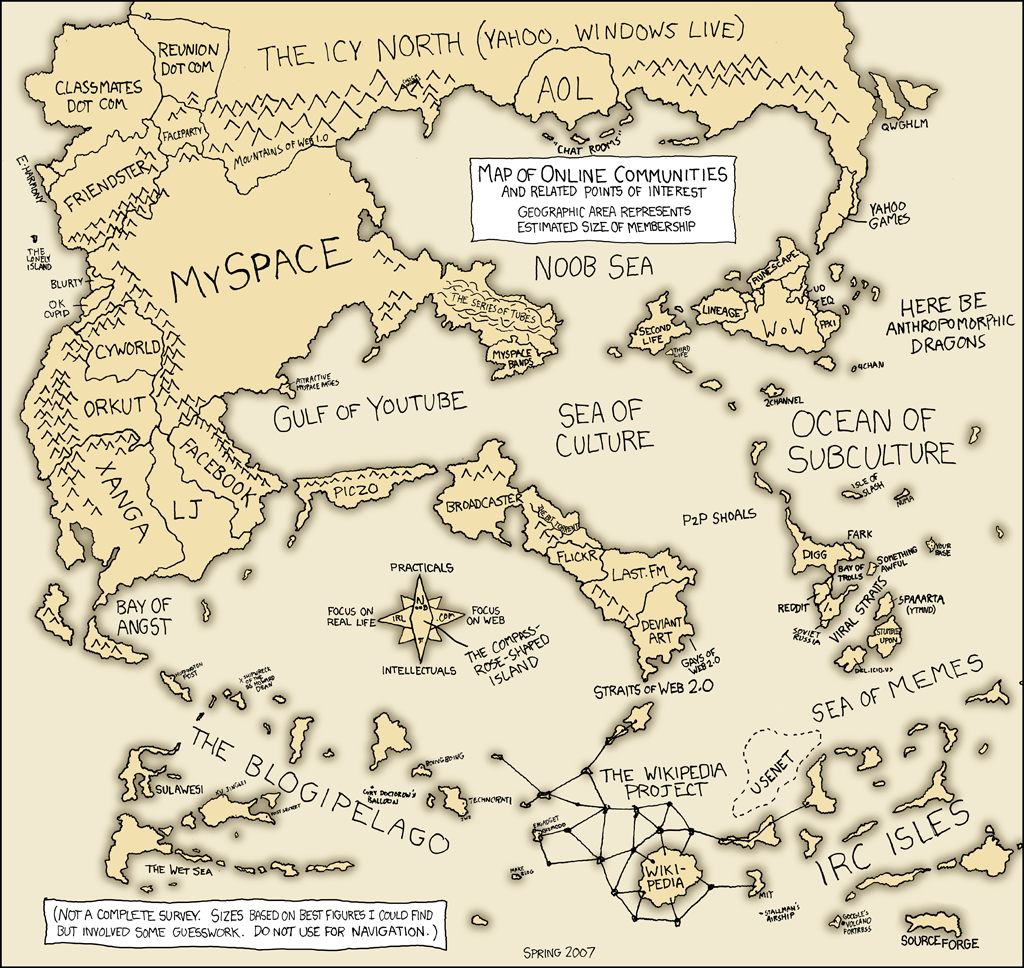
Awesome map depicting online communities by membership size and tenor. Serisouly, it's awesome. North is "practicals", South is "intellectuals", West is "focus on real life", East is "focus on the web".
Wikipedia's in the southeast. Good chance to brag about the disproportional readership our relatively small membership draws.
The City of a Thousand Pillars (Arabic: إرَم ذات العماد, Iramu ḏāt al-`imād) is a lost city on the Arabian Peninsula.
Tuesday, May 01, 2007
A gaikokujin tarento (外国人タレント) is a foreign celebrity active exclusively or almost exclusively in Japan.
Sunday, April 29, 2007
"And why, you might ask, is it even important to understand such an obscure, silly phenomenon? Why is it important to understand gaming culture, furries, or TV fandom? Should we not dismiss such embarrassing cultural idiocy, and lead humanity towards a golden age of a new enlightenment? I believe in the latter, but not in the former. If we want to advance as a species, we must understand what makes us tick. We must develop models that help us to explain why people form online communities around the idea of hunting menacing citrus fruits." via geoff

Thursday, April 26, 2007
Russian space dogs. In the 1950s and 60s, the Soviet Union launched missions with passenger slots for at least 57 dogs. The actual number of dogs in space is smaller, as some dogs flew more than once.
Wednesday, April 25, 2007
Anatoli Bugorski is a Russian scientist who was involved in an accident with a particle accelerator in 1978.


Tuesday, April 24, 2007
Monday, April 23, 2007
Saturday, April 21, 2007
Friday, April 20, 2007
Local-language roundup
Why utcursch doesn't contribute to Wikipedias in Indian languages:
Although I am capable of writing articles in at least two Indian languages (mr, hi), I don’t feel like contributing to these Indian-language Wikipedias, primarily because I believe that very few people read them.
Now-a-days, knowledge of English is becoming synonymous with Education, at least in urban India. More and more literate Indians can read, understand and write English today (In fact, it is widely believed that India has the largest number of English speakers in the World). Almost all of the internet users in India have knowledge of English and they primarily surf English-language sites.
Not that I’ve any dislike towards Indian languages (I’ve been involved with translation of FCKEditor, Moodle and Ubuntu), but when you feel that your efforts will go to vain, you just don’t feel like contributing.
Kelly Martin says the foundation should focus more on languages that are tied to a national identity -- that local-language wikipedias are a losing game in countries where English is associated with education and high status.
I'm not sure I agree. Wikipedias could potentially help revive the status of local languages -- but is that goal too ambitious/revolutionary/optimistic? It's hard to tell when, like me, you're a monoglot. I do remember showing the Farsi Wikipedia to one of my mom's Iranian neighbors, who was completely uninterested (he already know about the English Wikipedia).
Bèrto ëd Sèra writes on a similar topic. (Wow, there's a lot of traffic in the Wikiblogosphere these days. Drop out for a little and you fall behind.)
Thursday, April 19, 2007
Wednesday, April 18, 2007
Kongō Gumi Co., Ltd. was the world's oldest continuously-operating company, operating for over 1,400 years. The company fell on hard times and went into liquidation in January, 2006.
Tuesday, April 17, 2007
Zotero, a firefox extention-slash-research-tool, now meshes with wikipedia. I haven't used it, but by all accounts it makes creating citations within Wikipedia super-easy. (In other gadgetry...)
Monday, April 16, 2007
In British English, the term mockney has come to be used to describe those who present themselves as Cockneys (or, by extension, other working-class groups) with the intention of gaining popular credibility.
Saturday, April 14, 2007
William John Cavendish Cavendish-Scott-Bentinck, 5th Duke of Portland (September 12, 1800–December 6, 1879), was a British aristocratic eccentric who preferred to live in seclusion. He had an underground maze excavated underneath his estate.
Geoff's wikifying Ethiopia.
And about the blogger code of conduct:
The key to Star Wars is that Luke SkyWalker did not defeat Darth Vader by fighting him. Fighting the darkside only gives it power! The lesson for Luke was to appeal to Vader’s better nature. This is how civility works on Wikipedia, and the only way it can work on the internet.
...
Wikipedia has the potential to be one of the most contentious places on the internet. And yet it has developed a culture that can mediate any debate.
...
Web 2.0 started by reinventing Usenet badly, now they’re reinventing netiquette badly.
Friday, April 13, 2007
Thursday, April 12, 2007
Wednesday, April 11, 2007
Ogg Vorbis -- no future?
All of wikipedia's audio is in the open Ogg Vorbis format, which doesn't play on iPods (or a lot of other players). John Gruber warns that Ogg may never see wide use.
With regard to Ogg Vorbis, or the idea of “free” codecs in general, the consensus seems to be that this is an ugly patent lawsuit waiting to happen. Yes, the creators of Ogg Vorbis have released the format (and source code for encoding and playback) openly, but the holders of the patents behind MP3 (and other patented codecs) very likely consider part of Ogg Vorbis to violate their patents. If Apple, or any other company with a serious amount of money behind it, were to use Ogg Vorbis in a mainstream widely-used product, it could lead to an expensive lawsuit.
Do software patents suck? Yes. Is it possible that Ogg Vorbis does not actually infringe on anyone’s patent, but that some patent holder could sue and win even though they shouldn’t? Yes. The point is, Ogg Vorbis is intended to be free, and it would be great if it were free, but no one with deep pockets has yet tested the water to see whether it really is. Worse, there are some experts who do believe that Ogg violates at least one significant patent.
Tuesday, April 10, 2007
The Feynman Point is the sequence of six 9s which begins at the 762nd decimal place of π. It is named after physicist Richard Feynman, who once stated during a lecture he would like to memorize the digits of π until that point, so he could recite them and quip "nine nine nine nine nine nine and so on."
Wikifuturology
"I write these words in April 2007. If my prediction holds true then by the end of next year major news organizations will have research staffers who spend their working days reading Wikipedia edit histories. In a couple of years ordinary people won't just peruse your biography or your company's current Wikipedia entry when they decide whether to do business with you, they'll be clicking on alternate Google returns to see whether you've been in an arbitration case. Blogs and forking sites will chronicle ideological and corporate attempts to manipulate Wikipedia."
Monday, April 09, 2007
Light rail can carry as many passengers as a 16-lane freeway in the space of a two lane roadway. (Check out the pictures.)
If you want to know how to drive a streetcar ...
Also, a trolleybus is an electric bus powered by two overhead wires. And this is a cool picture.
The origin of the finger (gesture) is highly speculative, but is quite possibly thousands of years old. It is identified as the digitus impudicus ("impudent finger") in Ancient Roman writings[1] and reference is made to using the finger in the Ancient Greek comedy The Clouds by Aristophanes.
Sunday, April 08, 2007
Humor roundup
Wikipedia vs. Google
A rough guide to the state of the internet
Why wiki works (because it's a MMORPG?)
What Wikiepdia is not (outtakes)
And finally, the Encyclopedia of Stupid joins what is fast becoming a crowded field.
Friday, April 06, 2007
The Irony mark (؟) (French: point d’ironie).
"This mark was proposed by the French poet Alcanter de Brahm at the end of the 19th century. It was in turn taken by Hervé Bazin in his book Plumons l’oiseau (1966), in which the author proposes several other innovative punctuation marks, such as the doubt (


So much better than smilies. See also: Sarcasm mark. "Although a sarcasm mark exists in the Ethiopic languages it is not a standard form of punctuation in English."
Thursday, April 05, 2007
Imperial Life in the Emerald Wiki
I just finished reading "Imperial Life in the Emerald City," all about how the U.S. bungled the Iraq reconstruction by becoming ensconsed in the Green Zone and debating endlessly.
In real life you meet all sorts of people at school, or the gas station, or walking around. Online, everything's a room with a bouncer; there are all sorts of opportunities for closed circles, and sometimes I worry about getting too caught up in wikipolitical minutia.
Don't get me wrong -- if Wikipedia was anything at all like the U.S. Bagdhad presence I'd be off storming St. Petersburg or something. Er ... the St. Petersburg with palms, not the one with statues of Lenin. But there are all sorts of real-world wiki issues that aren't given enough attention -- "stupid user stories" are usually bad design stories.
This California newsman thought that "there's no way to tell who wrote the [Wikipedia] entry or how many people contributed to it" until one of his readers corrected him -- and he works for the media! How many regular people know how to check an article's contributors?
Put yourself in your parents' shoes: you're reading a page about Thailand that you found through Google, and you see a square that says "history". You click the square expecting to read about the history of Thailand and suddenly you're faced with a long, mysterious list of nonsensical words and numbers. You click the back button.
People are not born knowing how Wikipedia works, or what IANAL stands for, or the intended purpose of a program called Gimp.
The "history" problem could have been solved years ago by picking a better name for the tab -- even "article history" would be an improvement, and I thought of that in 5 seconds. "Previous versions of this article"? It would be a simple change, uncontroversial, easy to implement. But it would affect the experience of ordinary Wikipedia users way more than Merging Two of the Official Rules would, and how many megabytes of text were devoted to debating that?
The U.S. presence in Bagdhad had almost no Araibic-fluent staff, and they had no idea what was going on around them. We web-savy folk don't understand how ordinary people see the internet: the only way to really know is to show people the site, sit back, and see what they do.
I've watched web-designer friends click on the wrong edit-this-section link. The only wikipedia usability study that I know of identified the problem in Feb. 2006 and found that new users would often do the same thing -- and then they'd be so confused that they'd delete all the text in the section because it looked nonsensical to them. (How's that for vandalism?) It took a year to move the links a quarter-inch and fix the problem.
Right now there's not much mediawiki usability testing going on (Wikia's doing some, but it takes a long time to trickle back up), and not many people care. This is a problem.
Saturday, March 31, 2007
Friday, March 30, 2007
Wikipedia in 2003: "If rules make you nervous and depressed, and not desirous of participating in the Wiki, then ignore them and go about your business."
...and Today: "If the rules prevent you from improving or maintaining Wikipedia, ignore them."
Two things jump out:
1. The human touch is fading a little.
2. IAR was originally intended to keep people from quitting or collapsing underneath the beaurocracy (I know there's a Once Upon a Mattress reference in there somewhere), not to enable decisive leadership, or whatever. I don't know if the change is wholly a bad thing, but it's notable.
via
Thursday, March 29, 2007
Wikipedia vs. Citizendium
Citizendium is not Wikipedia.
Wikipedia is not Citizendium.
So far, both of those articles adhere to their stereotypes: Citizendium's is tight and well-written but full of straw men; Wikipedia's is more neutral, comprehensive, and messy.
Wikipedia sings in a few areas:
- Specific topics where enthusiasts congregate (from Peerage to Talib Kweli)
- Controversial issues with lots of nooks and crannies that get hammered out and disinfected by the sunlight of coverage (Muhammad cartoons, for example)
- Lists, where the huge userbase is harnessed best. (Anyone can just add a line-item.)
- Entries that are just incredibly fun, get linked all over the place, grow of their own accord.
- And finally, documentation of porn. (You know it's true.)
And of course, Citizendium doesn't have a horde of OCD ants scurrying to erect the greatest taxonomic and organizational frameworks ever created by man. On Wikipedia, you can go through history year by year -- or shuffle through sequential sumerian emperors, or flights of the pacific, or chart-topping albums.
But Wikipedia is a little weaker when it comes to topics that require a broad sweep and an incisive summary --sketching Mt. Fuji, as it were, with one or two strokes of the pen. All-you-can-eat is great, but once in awhile it's nice to have everything laid out for you, to go on the Epcot Center ride. (Compare the WP and CZ articles on Music.)
I should probably finish with something incisive, but it's late. I'll just say that Citizendium isn't 100th as useful as Wikipedia yet, but it could get there -- I hope so; there's room for both.
(Postscript. Citizendium apparently doesn't 'use the neologisms "NPOV" and "POV"; we use the old-fashioned English words "neutral" and "biased."' Yay! Acronymic gobbledigook is a scourge on Wikipedia, which is supposed to be all about tearing down barriers to entry.)
Friday, March 23, 2007
MADNESS? THIS IS WIKIPEDIA!!
Wales as a constitutional monarch:
Jimbo's role looks like a horrible, poorly-defined mess, but looking at this through a constitutional history perspective, it seems fairly straightforward. Jimbo once exercised many functions, which are defined essentially by use: the functions that he had, such as arbitration, were the ones he exercised. These functions are now exercised by other functionaries, governed by their own policies, although Jimbo still has a potential to exercise them. Jimbo retains what are essentially reserve powers, to be used in extraordinary circumstances, while the day to day exercise of power is governed by the equivalent of a constitution (the arbitration policy, for example). Pressure from the community will serve well enough to force constitutional conventions on Jimbo's use of authority. As long as the conventions are not breached, everything's peachy.
If Wales is Betty, maybe Sanger was Diana? Or maybe Wales is the first Elizabeth, so Sanger's Oliver Cromwell. That would make Tim Berners-Lee Charlemagne and Lessig Churchill. Or maybe Wales is Churchill with war powers, Conservapedia is Tokugawa (see? that joke could have been a lot worse) and Disinfopedia is the swiss. Encyclopedia Dramatica gets to be Mussolini.
I think someone british needs to do this.
(Counterpoint: Wales is an
Thursday, March 22, 2007
Wikivid is mediawiki-based video-sharing thingy. A lot of good instructional videos about software (Flash, Illustrator, RoR, Logic, Maya, etc.), but the editing interface is clumsy. The just-the-facts approach makes seem like the creators wanted to make something "like wikipedia, but with video!" but that won't happen until you can actually edit the videos collaboratively online (I give it 5 years).
Wednesday, March 21, 2007
The Capgras delusion is a rare disorder in which a person holds a delusional belief that an acquaintance, usually a spouse or other close family member, has been replaced by an identical looking impostor.
The Fregoli delusion is a rare disorder in which a person holds a delusional belief that different people are in fact a single person who changes appearance or is in disguise.
The syndrome of subjective doubles is a rare delusional misidentification syndrome in which a person suffers from the delusion that he or she has a double or doppelgänger with the same appearance, but usually with different character traits and leading a life of its own.
The Cotard delusion is a rare neuropsychiatric disorder in which a person holds a delusional belief that he or she is dead, does not exist, is putrefying or has lost his/her blood or internal organs.
Mirrored self-misidentification is the delusional belief that one's reflection in a mirror is some other person (often believed to be someone who is following them around).
Reduplicative paramnesia is the delusional belief that a place or location has been duplicated, existing in two or more places simultaneously, or that it has been 'relocated' to another site.
Monday, March 19, 2007
Sunday, March 18, 2007
Spik is a delicious word, meaning variously the innards of a monkey, the part of a hat that touches the top of your head, or a kind of flammabble elk, wiped out by deforestation.
Saturday, March 17, 2007
Friday, March 16, 2007
This isn't dead-on wiki-related, but ficlets is a cool new collaborative writing site -- you can submit a microstory of up to 1024 characters, and other people can write prequels and sequels, building sprawling nonlinear (and commons-licenced) narratives. It's from AOL, of all companies, but it's so well thought-out that you'd think it and AOL would explode on contact like matter and antimatter. (I'm helping write a cyberpunk programming firefox fanfic about a mad scientist type.)
In other gadgetry, Wikia just launched what it calls Wiki magazines, which basically seem to be wikified versions of digg -- instead of pointing offsite, the voted-on links go to on-site stuff. Neat stuff.
Kelly martin notes approvingly that the inclusionists have been gaining ground, and proposes replacing "notability" with an interesting new standard: maintainability.
A record of my breakfast yesterday (for the record, two glazed Dunkin Donuts and a bottle of Aquafina) is unverifiable, and thus unmaintainable, and thus unfit for inclusion in Wikipedia. Verifiability isn't enough for maintainability, but it's definitely a minimum characteristic.
Thursday, March 15, 2007
Something called Colony Collapse Disorder is killing off bees in huge numbers, and "Honey bees are responsible for approximately one third of the United States crop pollination".
Wednesday, March 14, 2007
pediax is a Wikipepedia mirror all tricked out with ajax. It's fucking cool -- the front page is Google Maps, showing the most popular articles in the field of view spearheaded on their locations. I just scrolled from michigan to nyc, picking out stops along the way; it's pretty great. (The actual article pages are slow, glitchy, and generally misguided.)
'People in Sioux Lookout, Ont., expressed shock and outrage after reading derogatory comments about their town in a brochure distributed to local businesses.
The brochure, a type of business directory distributed to hotels in the community, said Sioux Lookout was "full of drunks" and "a dirty little town." It also suggested people living in the community should move.'
Stable versions, anyone? (Or maybe just read articles before you republish them, and disclose their source.)
Tuesday, March 13, 2007
Wikipedia and Conservapedia go head to head on the BBC (realaudio). It's an entertaining listen.
Human echolocation is the ability of humans to sense objects in their environment by hearing echos off those objects.
Sunday, March 11, 2007
"Wikileaks.org is a site dedicated to the apparently untraceable leaking and analysis of documents from oppressive regimes." -via
Wednesday, March 07, 2007
Nemo 33 is a recreational diving center in Uccle, Belgium near Brussels that is home to the world's deepest swimming pool.
Monday, March 05, 2007
The NYTimes recap says that the Essjay story 'shows how the transparency of the Wikipedia process...allows readers to react to suspected fraud. ... By Saturday, the prevailing view was summarized in subject lines like Essjay Must Resign, and notes calling Mr. Jordan’s actions “plain and simple fraud.”' (Bonus: The fairest, pithiest conclusion yet. Someone had to do it.)
Andrew Lih says that when all is said and done, maybe the New Yorker should have checked their facts better (being, you know, the New Yorker).
Saturday, March 03, 2007
Andrew Lih underscores the severity of the essjay case with his usual eloquence. Before pointing out that essjay may have defamed or libeled a Pulitzer prize-winning journalist, he says:
This is now an internal crisis of confidence. What company does the community keep? What happens when after assuming good faith, we discover the depths of betrayal go this deep? The Wikipedia community is notoriously full of touchy-feely assume good faith WikiLove and quick to forgive.
Alright, folks. I've trawled the depths of the paraphilia section and dug up the articles that are funny and not gross.
Anesthesia fetishism is a very specialized sub-category of medical fetishism in which sexual arousal is induced by the idea of general anesthesia, and the various equipment and paraphernalia related to its use. Pyrophilia is a relatively uncommon paraphilia in which the patient derives gratification from fire and fire-starting activity. Robot fetishism is a fetishistic attraction to humanoid or non-humanoid robots; also to people acting like robots or people dressed in robot costumes. A less common fantasy involves transformation into a robot. Spectrophilia is the paraphilia involving sexual attraction to ghosts and spirits. Tamakeri is a sexual fetish and subgenre of pornography in Japan. In tamakeri pornography, a female kicks a man in the testicles.
Jimmy Wales has diminished the weirdness of the Essjay scandal:
I have been for several days in a remote part of India with little or no Internet access. I only learned this morning that EssJay used his false credentials in content disputes. I [previously] understood this to be primarily the matter of a pseudonymous identity (something very mild and completely understandable given the personal dangers possible on the Internet) and not a matter of violation of people's trust (...)
I have asked EssJay to resign his positions of trust within the community (...)
Wikipedia is built on (among other things) twin pillars of trust and tolerance. The integrity of the project depends on the core community being passionate about quality and integrity, so that we can trust each other. The harmony of our work depends on human understanding and forgiveness of errors.
Friday, March 02, 2007
Oy. There's a complicated, messy scandal unfolding.
Update: Wales has asked Essjay to resign his positions at Wikipedia. Wales was in rural India when the scandal broke and didn't have reliable internet access.
Essjay, one of the most powerful admins on Wikipedia, presented himself for years as a 40-something "tenured professor of religion at a private university with a Ph.D. in theology and a degree in canon law" (on his user page and to the New Yorker magazine -- scroll to the bottom for their correction)
In fact Essjay is a 24-year-old from Kentucky. At first this story seems like a standard case of con-artistry, and I wasn't going to cover it because it looked like someone self-destructing. But I don't think that's what's going on. Let's count the unexpectednesses:
1. Essjay outed himself.
2. He outed himself quietly * on his Wikia profile page after Wikia hired him. (Wikia is Jimmy Wales' wiki-community startup.)
3. Talking to the New Yorker, Jimmy apparently stood behind Essjay: 'Jimmy Wales, the co-founder of Wikia and of Wikipedia, said of Essjay’s invented persona, "I regard it as a pseudonym and I don’t really have a problem with it."' **
To paraphrase Neal Stephenson, this story is fractally weird: each microscopic part of it is just as weird as the whole thing.
So what gives? Essjay says he invented the persona to protect himself from "trolls, stalkers, and psychopaths who wander around Wikipedia and the other Wikimedia projects looking for people to harass, stalk, and otherwise ruin the lives of" -- wikipedia-watch's Daniel Brandt (who claims to have dug up the story, though as far as I can tell he just found the Wikia profile and contacted the New Yorker) seems crazy enough *** for me to sort of believe it. After years deep in the Wikipedia trenches, conducting the sort of business that has to be conducted (like banning spammers and neonazis) maybe you're exposed to lots of dangerous characters. You don't have to look hard for people who've gotten death threats.
But with some perspective: this is a big deal. Essjay's apparently used his fake credentials to influence wiki content, for one. I don't know who can read this without feeling a twinge of betrayal, even if Essjay did donate thousands of hours of his time to Wikipedia and is by all accounts a really cool guy.
The whole thing plays into the worst generalizations about Wikipedia and scares off the real academics it needs to attract. Wikipedia is self-reinforcing: it works best when its contributors take it seriously. Thankfully, they do. Cyde Weys sez:
...for every page I mentioned here, there was an active talk page full of people arguing that I didn’t link. So double the number of pages devoted to this one incident.
Wikipedians aren’t taking this one lying down. They’ve already written over a megabyte of text on the incident. Wikipedians are, if nothing else, creators of voluminous amounts of text. They also realize the importance of what Essjay did and how bad it makes Wikipedia look, and most of them want some action taken to rectify the situation.
* Essjays says most of the Wikipedians he knows well already knew he wasn't a professor. But (charitably) he obviously got carried enough away with his persona to pass himself off to a New Yorker editor. (This story hurts them, too: "It only took the magazine's vaunted fact-checking department seven months to discover that Essjay is actually a 24-year-old named Ryan Jordan who has never taught anything and holds no advanced degrees.")
** Wales was in India when he talked to the New Yorker, and perhaps not adequately informed.
*** Brandt devotes himself to exposing the real-world identities of Wikipedia admins. An understandable goal, I guess, but "abrasive and paranoid" doesn't begin to describe him. I haven't been following his hijinks closely, but I get the feeling that a lot of people spend a lot of energy trying not to interact with him.
Bonus: A commenter at Freakonomics points out that in academic arenas, words sometimes speak louder than actions:
One of the major contributors to the Oxford English Dictionary only corresponded by letter (and did so for free, I believe). He had plenty of time to write up his letters, because he was locked up in one of England’s Asylums for the Criminally Insane. The guy running the project didn’t know this for quite some time, and it doesn’t change that even while mad, he contributed something valuable. (Check out http://www.amazon.com/Professor-Madman-Insanity-English-Dictionary/dp/0606306978 which seems to be a book on it for confirmation) I’d be worried much more about the pretentious mediocrities than the simply lying, criminal, or crazy types.
And here's an interesting comment from digg, of all places:
The demand for knowledge is being catered by wikipedia and as usual demand fuels supply thus the only way forward is for authoritative academics move on to the virtual world and take advantage of the medium. Maybe citizendum might fill in gaps however, wikipedia should always exist as a glorified sandbox. The bottom line is this is no big deal. Jimmy Wales did the right thing.. a 24 year old spent a major part of his life building up knowledge. i understand him.. i hope you too
Also be sure to read Kelly Martin's commentary (one, two, three), which is much less forgiving than mine.
Finally, Andew Lih has the clearest summation I've seen.
Wednesday, February 28, 2007
The journal Nature: "...the Wiki community has mutated since 2001 from an oligarchy to a democracy. The percentage of edits made by the Wikipedia 'élite' of administrators increased steadily up to 2004, when it reached around 50%. But since then it has steadily declined, and is now just 10% (and falling)."
Truth In Numbers is a documentary about Wikipedia (currently in production). Here's the first trailer:
It looks like it's going to be really good -- the crew is crisscrossing asia right now (you can follow their progress here), which is where the real Wikipedia esprit de corps is.
Saturday, February 24, 2007
The Walking City was an idea proposed by British architect Ron Herron in 1964. In an article in avant-garde architecture journal Archigram, Ron Herron proposed building massive mobile robotic structures, with their own intelligence, that could freely roam the world, moving to wherever their resources or manufacturing abilities were needed. Various walking cities could interconnect with each other to form larger 'walking metropolises' when needed, and then disperse when their concentrated power was no longer necessary.
Slate magazine: "Wikipedia's notability policy resembles U.S. immigration policy before 9/11: stringent rules, spotty enforcement."
Same topic: Scott McCloud, patron saint of webcomics (and comics in general) is "fed up with Wikipedia".
There's a lot to be said about notability guidelines, but it's all been said so many times. (Google inclusionist deletionist.) It's clear, at this point, that something should be done. But that's like writing "americans shouldn't vote for republicans" -- easier said than done. Wikipedia is now a complex society and culture, with its own internal dynamics and inertia.
Too, there's a balance to be walked, and nobody knows quite how to walk it. How do you keep major webcomics in, but still make sure Flat-Earthers and guru-come-con-artists can't finesse their way into exuberant coverage?
Good quote from the Slate article:
When people go to this much trouble to maintain a distinction rendered irrelevant by technological change, the search for an explanation usually leads to Thorstein Veblen's 1899 book, The Theory of the Leisure Class. This extended sociological essay argues that the pursuit of status based on outmoded social codes takes precedence over, and frequently undermines, the rational pursuit of wealth and, more broadly, common sense. Hierarchical distinctions among people and things remain in force not because they retain practical value, but because they have become pleasurable in themselves. Wikipedia's stubborn enforcement of its notability standard suggests Veblen was right. We limit entry to the club not because we need to, but because we want to.
Tuesday, February 20, 2007
I'm cherrypicking wiki-related posts from my reader -- check the left sidebar (or this page, if you want all of them).
A gravity train is a theoretical means of transportation intended to go between two points on the surface of a sphere, following a straight tunnel that goes directly from one point to the other through the interior of the sphere.
Wednesday, February 14, 2007

Tuesday, February 13, 2007
What will Wikipedia be like in 5 years? Great blog post.
via
I'm pretty sure all this stuff will come true -- if it doesn't happen on the main site, it'll happen via greasemonkey-style mashups. Interesting digression:
In general, scientists (especially in the "harder" fields) and mathematicians have shown a great deal more enthusiasm than humanists, with social scientists somewhere between. (I find this ironic, because humanities fields have so much more to gain from an integrated and cross-linked ecology of knowledge; despite constant flux and discipline genesis at the borders and the current rhetorical vogue of "interdisciplinary" research, science topics are relatively self-contained compared to humanities topics.)
Did I mention that I like Wikiworld? It's exactly like this blog, only a comic.
Saturday, February 03, 2007
Friday, February 02, 2007
S. A. Andrée's Arctic balloon expedition of 1897.
I just recorded a spoken version.
Wednesday, January 31, 2007
Chikyu Hakken, Japanese for "Earth Discovery", is a half-billion dollar project that aims to be the first to drill seven kilometers beneath the seabed and into the Earth's mantle, three times deeper than ever drilled before.
Tuesday, January 23, 2007
There's a new policy: outgoing links from Wikipedia will be marked as "nofollow" for search engines. Kottke has some interesting commentary.
Microsoft tried to pay people to slant Wikipedia articles in their favor. (This story speaks more to MS's keystone cops style marketing than their evilness. Any truly evil corporation would be competent enough to make sure the story didn't leak.)
Subscribe to:
Posts (Atom)