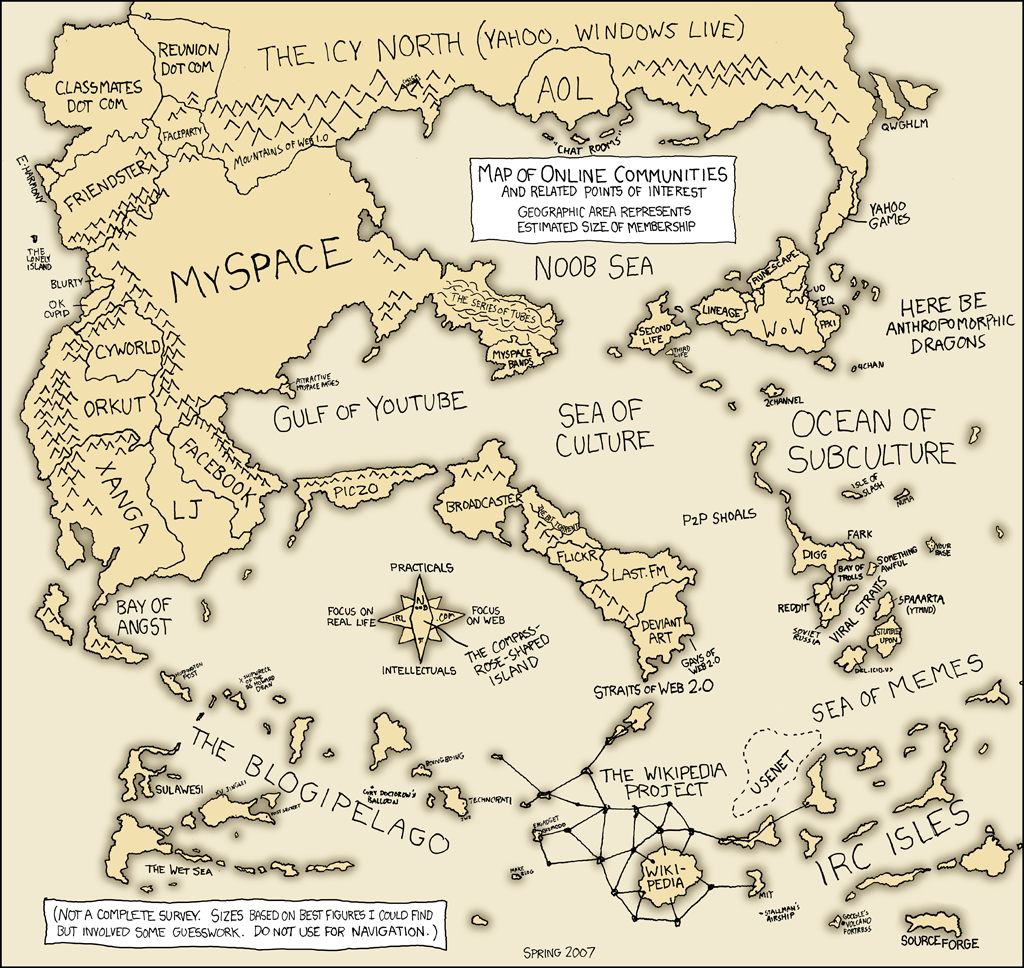
The people who brought you the 10,000-year clock are excited about Wikipedia's potential as a canonical "Futurepedia".
Think about articles like 2020 -- "If expanded greatly the official future timeline might prove to be a useful document of what we expect."
I hate to be the one to break it to them, but there's no way that's going to happen within Wikipedia proper. It's not verifiable. It doesn't cite authoritative sources. It's not encyclopedic. Basically, it breaks all the rules, and it'll get slapped down before it gains any steam. Wikipedia's incredible realized potential lives side by side with a lot of squandered potential.
You're not going to win this one by fighting it out in the AfD trenches -- anyway, 1head-to-head combat isn't the wiki way. Wikipedia desperately needs to be nested inside some broader, more permissive architecture.
Friday, February 01, 2008
Tuesday, January 29, 2008
Florence: Wikipedia will have stable versions, wiki-to-print, and collaborative video editing.
F.D.: First of all, improvements to the software. This is something that's been under discussion for two and a half years: stable versions. The idea is to be able to identify which versions have been validated, and to enable users to see both the current version and the last version that was accepted as being more or less correct.
The second innovation, which I hope will become available in spring, is to give people the chance to put together a small personalised pdf file or paper version containing a selection of articles. Suppose, for example, that I want to know all about the Davos forum. I put things in a basket, just as on Amazon: the article on Davos, articles about the various personalities attending, global warming or the economic crisis. I compile my own little book which I can buy and have sent to me. That is Wiki to Print.
The third innovation, probably in autumn 2008 will be the possibility of adding videos to Wikipedia and editing them collaboratively, like a wiki text. That should be really, really good!
Wiki-to-print has been around for awhile as pediapress, but there were all sorts of problems with the implementation. Now that I check their site, it looks like they've "entered a long term partnership with the Wikimedia Foundation". Sweet. Here's the press release from a month ago; it looks like this slipped completely under the radar.
"Project Chanology" began as an Internet-based protest against the controversial Church of Scientology by "Anonymous", a group described as "a disparate collection of hackers and activists".
Sunday, January 27, 2008
Friday, January 25, 2008
Thursday, January 24, 2008
Shipping container architecture is an uncommon form of architecture that involves the use of steel shipping containers as the basis for housing and other functional buildings.
By the way, let me know if the new layout has problems or if the ads piss you off.
Wednesday, January 23, 2008
Hundreds and hundreds of coats of arms, vectorized.
Check this one out (SVG link). This too, actually. And this.
(Thanks, adam.)
The Great Hacker War was a 1990–1991 conflict between the Masters of Deception (MOD) and a faction of the older guard hacker group Legion of Doom (LOD).
Tuesday, January 22, 2008
Monday, January 21, 2008
Friday, January 18, 2008
Eigengrau (German: "intrinsic gray"), also called eigenlicht ("intrinsic light"), dark light, or brain gray, is the color seen by the eye in perfect darkness. Even in the absence of light, some action potentials are still sent along the optic nerve, causing the sensation of a uniform dark gray color.
(If you can't see the poll above -- or even if you can, and you just want to look at spiffy results map -- then follow this link.)
Thursday, January 17, 2008
Websites personified (Wikipedia is at 2:55, though the best one is Facebook, at 1:50)
Really funny. The actual title is "The Internet Party: What Happens When Google's Parents Leave Town for the Weekend?" see also
Wednesday, January 16, 2008
For many Wikipedians -- if not most -- contributing to it is probably the most important influence they will have on the greater world.
In my own case, while I am not some 15-year-old fanboy living in my parents' basement writing articles about videogames or anime characters, this is true. I could stop contributing today & devote my energy to something (so to speak) more socially acceptible -- catch up on my yardwork, tutor children in a local school, volunteer for a political campaign -- yet nothing else will have the same persuasive effect on so many people as contributing to Wikipedia.
Much the same thing happened after World War II in the United States: a lot of books were published about the war because there were a lot of veterans (& parents, sisters, & brothers of veterans) who wanted to read about what they had been part of.
Fortunately I defined my life long before Wikipedia came around, so while I know its importance, I can tear myself away from it & devote myself to other things, most of which are more important than whether an article on Charles Darwin should include the fact tha the was born on the same day as Abraham Lincoln. (Or whoever those 2 people were that led to a silly edit war a few years back.) However, there are many people who have not done this, & their numbers can only increase. ("Wow, anyone can edit this? My words will be read by millions? This is way cooler than the drudgery of my daytime job.")
One could describe them as having encountered sunlight after dwelling underground for a long time; they are blinded by Wikipedia's importance, & have no way to put things into a healthy proportion. (And maybe the rest of the Platonic allegory applies in this case.) These members fight over every dispute viciously for an immediate solution because they cannot envision why allowing Wikipedia content to develop & mature could be a good thing.
Tuesday, January 15, 2008
Sunday, January 13, 2008
Simo Häyhä (December 17, 1905 – April 1, 2002), nicknamed "White Death" by the Soviet army, was a Finnish soldier, and is widely considered to be the most successful sniper in history.
Wednesday, January 09, 2008
Sunday, January 06, 2008
NYTimes: Did proto-science-fiction writer J. Borges predict Wikipedia? (He did, after all, spend his life in a library.)
THEN [1940] “What person, or people, invented Tlön? People, I suppose, for sure, since the idea of a single inventor — some infinite Leibniz working in obscurity and self-effacement — has been unanimously rejected. It's thought that this ‘brave new world’ is the work of a cabal of astronomers, biologists, engineers, metaphysicians, poets, chemists, algebrists, moralists, painters, geometers, ... guided and directed by some shadowy genius. There are many men adept in those diverse disciplines, but few capable of imagination — fewer still capable of subordinating imagination to a rigorous and systematic plan. The plan is so vast that the contribution of each writer is infinitesimal.” Tlön, Uqbar, Orbis Tertius
NOW Wikipedia, the online encyclopedia project that began in 2001, now has a total of more than nine million articles in more 250 languages. There are more than 75,000 “active contributors,” many of whom remain anonymous. As it grows and becomes ever more influential, its operating logic remains a mystery. A favored saying among Wikipedia’s contributors is: “The problem with Wikipedia is that it only works in practice. In theory, it can never work.”
Reading Borges quotes you can feel a unity of life and wiki:
- If the pages of this book contain some successful verse, the reader must excuse me the discourtesy of having usurped it first. Our nothingness differs little; it is a trivial and chance circumstance that you should be the reader of these exercises and I their author.
- The universe (which others call the Library) is composed of an indefinite and perhaps infinite number of hexagonal galleries, with vast air shafts between, surrounded by very low railings.
- No one is anyone, one single immortal man is all men. Like Cornelius Agrippa, I am god, I am hero, I am philosopher, I am demon and I am world, which is a tedious way of saying that I do not exist.
- The exercise of letters is sometimes linked to the ambition to contruct an absolute book, a book of books that includes the others like a Platonic archetype, an object whose virtues are not diminished by the passage of time.
- A man sets out to draw the world. As the years go by, he peoples a space with images of provinces, kingdoms, mountains, bays, ships, islands, fishes, rooms, instruments, stars, horses, and individuals. A short time before he dies, he discovers that the patient labyrinth of lines traces the lineaments of his own face.
- I thought of a labyrinth of labyrinths, of one sinuous spreading labyrinth that would encompass the past and the future and in some way involve the stars.
- Life itself is a quotation.
(By the way, anyone who likes Borges should check out Greg Egan.)